Fifty Geniuses
by
Lawrence E. Rogers
Introduction
 The purpose of these 50 one-page descriptions of persons of genius is to remind readers of historical persons who are worth knowing better.Each of these fifty geniuses is the subject of many scholarly books that are readily available in our wonderful public libraries.
Persons of Genius
Date of Birth1 Moses 13th century B.C.
Moses 13th century B.C.2 King Solomon 10th century B.C.
King Solomon 10th century B.C.3 Homer 8th century B.C.
Homer 8th century B.C.4 Confucius 6th century B.C.
Confucius 6th century B.C.5 Socrates 470 B.C.
Socrates 470 B.C.6 Hippocrates 460 B.C.
Hippocrates 460 B.C.7 Plato 429 B.C.
Plato 429 B.C.8 Aristotle 384 B.C.
Aristotle 384 B.C.9 Cicero 106 B.C.
Cicero 106 B.C.10Virgil 70 B.C.
Virgil 70 B.C.11Seneca 4 B.C.
Seneca 4 B.C.12Justinian 483 A.D.
Justinian 483 A.D.13Charlemagne 742 A.D.
Charlemagne 742 A.D.14Alfred the Great 849 A.D.
Alfred the Great 849 A.D.15Louis IX 1214 A.D.
Louis IX 1214 A.D.16Dante 1265 A.D.
Dante 1265 A.D.17Chaucer 1345 A.D.
Chaucer 1345 A.D.18Gutenberg 1397 A.D.
Gutenberg 1397 A.D.19Joan of Arc 1412 A.D.
Joan of Arc 1412 A.D.20Columbus 1451 A.D.
Columbus 1451 A.D.21Leonardo da Vinci 1452 A.D.
Leonardo da Vinci 1452 A.D.22Copernicus 1473 A.D.
Copernicus 1473 A.D.23Michelangelo 1475 A.D.
Michelangelo 1475 A.D.24Thomas More 1478 A.D.
Thomas More 1478 A.D.25Galileo 1564 A.D.
Galileo 1564 A.D.26Shakespeare 1564 A.D.
Shakespeare 1564 A.D.27Pascal 1623 A.D.
Pascal 1623 A.D.28Dryden 1668 A.D.
Dryden 1668 A.D.29Alexander Pope 1688 A.D.
Alexander Pope 1688 A.D.30Samuel Johnson 1709 A.D.
Samuel Johnson 1709 A.D.31Rochambeau 1725 A.D.
Rochambeau 1725 A.D.32Edmund Burke 1729 A.D.
Edmund Burke 1729 A.D.33Joseph Haydn 1732 A.D.
Joseph Haydn 1732 A.D.34James Madison 1750 A.D.
James Madison 1750 A.D.35Jane Austen 1775 A.D.
Jane Austen 1775 A.D.36Daniel O’Connell 1775 A.D.
Daniel O’Connell 1775 A.D.37DeTocqueville 1805 A.D.
DeTocqueville 1805 A.D.38Abraham Lincoln 1809 A.D.
Abraham Lincoln 1809 A.D.39Charles Dickens 1812 A.D.
Charles Dickens 1812 A.D.40Dostoyevsky 1821 A.D.
Dostoyevsky 1821 A.D.41Pasteur 1822 A.D.
Pasteur 1822 A.D.42Mendel 1822 A.D.
Mendel 1822 A.D.43Lister 1827 A.D.
Lister 1827 A.D.44William Osler 1849 A.D.
William Osler 1849 A.D.45Robert L. Stevenson 1850 A.D.
Robert L. Stevenson 1850 A.D.46Toscanini 1867 A.D.
Toscanini 1867 A.D.47Montessori 1870 A.D.
Montessori 1870 A.D.48Theresa Martin 1873 A.D.
Theresa Martin 1873 A.D.49Fleming 1881 A.D.
Fleming 1881 A.D.50J.R.R. Tolkien 1891 A.D.
J.R.R. Tolkien 1891 A.D.“The mighty minds of old; My never-failing friends are they, With whom I converse day by day.” Robert SoutheyMoses
One of the most awe-inspiring persons in history is Moses who lived in the 13th century, B.C. He was a teacher, a prophet, a leader of his people, and a messenger of God.At the time of his birth, the life of Moses was in danger because the Pharaoh had ordered the killing of newborn Hebrew males in order to limit the growth of the Hebrew population. Moses was hidden by his mother in a reed basket placed at the edge of the Nile River. He was found by a daughter of the Pharaoh, and he was reared as a prince until the age of about twenty. A crisis occurred when he was identified as a Jew. He had to flee from Egypt.The humanity of Moses was made evident by his reluctance to accept the dangerous assignment as God’s messenger to the Pharaoh. At first, Moses refused saying, “Why me?”From the time of his return to Egypt, the life of Moses was marked by one courageous act after another. His struggle with the Pharaoh is one of the great dramas of history.The second assignment of Moses was as a messenger of God to carry to the people the Ten Commandments.Moses never reached the promised land. His death and burial are events that remain as mysteries to the present time.When Moses had his first encounter with God, Moses asked about God’s name. God identified Himself as Yahweh which means He Who Creates. This revelation made Moses recognize the God of the Hebrews as the sovereign lord over the entire world.Solomon
Many persons of genius are to be found in the Old Testament of the Bible. One is King Solomon. The date of his birth is unknown, but his date of death is 922 B.C.The Italian poet, Dante, praised Solomon for asking God for the knowledge and wisdom to be a good ruler rather than asking for riches or for a long life for himself.In the Divine Comedy, Dante wrote:“How, then was Solomon without a peer? Would be the question thou wouldst put to me. But so thou mayst see clear what now is dark, Consider who he was, and what impelled him To make his just request, when God said: ‘Ask!’ My words have been so clear that thou canst see He was a king who asked for greater wisdom In order to become a worthy king.”Solomon is renowned as the greatest of the kings of Israel. Under Solomon, the nation enjoyed security and prosperity.The building of the famous temple in Jerusalem was one of Solomon’s achievements. The site of this temple is the central shrine from Judaism.Wise teaching of Solomon is to be found in the Book of Proverbs. He is credited with the composition of one thousand songs as well as the biblical Song of Solomon.A story has been told over and over through the centuries of Solomon’s strategy in identifying the true, loving mother of an infant when another woman insisted that she was the baby’s mother.Since the time of Solomon, political leaders have been aware that wisdom is supposed to govern their official actions.Homer
We know very little about the Greek poet, Homer, and yet we recognize his genius in his writing. He produced two epic poems, the Iliad and the Odyssey.Homer probably composed these poems about 750 B.C. His term for a poet was “a singer.” The poems were composed and recited before written literature was developed.The Iliad consists of 15,693 hexameter lines: the Odyssey consists of 12,110 hexameter lines.Are you repelled by the violence found in these poems? The Iliad tells of a nine year siege and conquest of the city of Troy; the Odyssey tells of the fantastic adventures of Odysseus in returning home to his wife and son after the end of the Trojan War.Achilles, the greatest of the Greek warriors, is the central character of the Iliad; and Odysseus, a more resourceful warrior, is the central character of the Odyssey. The Iliad is the more important of the two poems.Scholarly persons today throughout the world continue to study these epic poems just as other scholars in all of the centuries of history had studied them. These poems are part of the legacy of mankind.Confucius
We can learn much about the culture of China by reading about the genius, Confucius, who lived for about seventy-three years from about 551 B.C. to 479 B.C.Many today think that Confucius was a religious leader, but he was primarily an educator. He is reputed to be the greatest teacher in China in antiquity.As a young person, he applied himself to scholarly work and he acquired an immense knowledge of Chinese history, Chinese rituals, ethics, language, and administration of governmental affairs.At about the age of thirty, he set himself up as a private teacher. Over his lifetime, about three thousand persons studied directly under his guidance. His pupils rose to positions of importance throughout China.His advice to students was to cultivate their intellects and strengthen their character. Moral improvement was at the heart of his teaching.Confucius taught love of humanity and service to fellow creatures. First we should fulfill our duties to our family. Next we should cultivate friends. He said that each person has the capacity and the necessary willpower to become a person of good character. Ability and moral excellence were qualities needed for a person to be a good leader.Socrates
The oracle at Delphi identified Socrates as the wisest man in Greece. This genius lived in Athens from 470 B.C. to 399 B.C.If Socrates were alive at the present time, there would be many people who would love him and many others who would hate him. This is exactly what occurred during his lifetime.People hated him because he caused them to look closely at their ideas and their behavior. Many persons were made to see their illogical ways of thinking and behaving.Young persons found the ideas of Socrates to be stimulating. They were helped to think clearly about important issues in their lives, especially issues relating to ethics and politics. Enemies of Socrates brought formal charges against Socrates of corrupting youths. He was found guilty by a jury and he was sentenced to death.Socrates rejected an opportunity to escape saying that he regarded obedience to the law as a duty. Furthermore, he said that he believed that after death, he would enter upon a new life.The teaching method of Socrates is still being followed by many educators. He asked question after question to force his students to think of logical answers. This cross examination procedure guided students to discoveries of truths.The fact that good appearance is not essential to the acquisition of many friends is shown in the life of Socrates. He had an ugly appearance with a large, square, bald head, prominent eyes, broad nostrils, and a wide mouth.Hippocrates
The man traditionally regarded as the Father of Medicine is the Greek physician, Hippocrates. His date of birth was about 460 B.C. and his date of death about 377 B.C.He is said to have written seventy works on medicine. Sixty of these writings are still extant.The Hippocratic Oath is attributed to him. This oath has served as a guide for the behavior of the medical professionals through the centuries. The Oath is currently used in the graduation exercises of many medical schools. The Oath reads in parts as follows:“I take to witness all the gods, all the goddesses, to keep according to my ability and my judgment the following oath: I will prescribe regimen for the good of my patients … and never do harm to anyone … I will preserve the purity of my life and my art …”Physicians are practitioners of modern science who enter into the intimate aspects of the lives of their patients. Hippocrates advised doctors to keep confidential the secrets revealed to them in their daily work.Widely followed today is this advice given by Hippocrates:“All parts of the body which have a function if used in moderation and exercised … become thereby healthy, well-developed, and age more slowly.”Plato
On every list of the ten most brilliant persons who have ever lived should be the name of Plato. He lived in Athens from 429 B.C. to 347 B.C.At the age of twenty-eight, Plato had been horrified by the stupidity of the government that condemned and executed Socrates. Plato became convinced that the tragedy of democratic government was that incompetent persons secured positions of authority.Plato wrote The Republic to show how government should be directed by persons outstanding in goodness and wisdom. He believed that superior knowledge is the characteristic of a true statesman just as knowledge distinguishes the true physician from the quack.In the ideal society of Plato, each citizen would perform the type of work for which the person was best suited.Later in life, Plato wrote a book known as The Laws which showed that law is a civilizing force. Law embodies wisdom in written form.Plato taught that every person should make rational principles preside over emotions and appetites. He indicated that a new type of life begins for us after our mortal bodies die. He told a story of a slain soldier who returned to life with a message that the just and the unjust are separated in the afterlife.Plato’s school in Athens was called The Academy. Some scholars regard The Academy as the first university.Aristotle
The greatest genius of the ancient world was Aristotle who was a student of Plato. Aristotle lived from 384 B.C. to 322 B.C.The focus here is on Aristotle as a genius in the field of philosophy. For Aristotle, the soul of a human being was the fundamental source of vegetative, sensitive, and rational powers. Human beings are both material beings and spiritual beings. A person’s rational powers are supposed to rule over sensitive appetites; reason must rule over passion.Aristotle advocated that human beings should form good habits in order to promote personal happiness. Young persons need the help of parents and of teachers to learn to keep their passions and emotions under the control of reason.Family life provides persons food, shelter, personal love and friendship, and the propagation of the human race. Government provides security by maintaining ethical standards. The purpose of government is to provide for the common good of all the people.Aristotle recommends the doctrine of the mean, which involves taking a middle course between two extremes. In governmental affairs, trouble arises if the very rich or the very poor have complete control. The doctrine of the mean dictates that most authority should reside with the middle class.Cicero
Cicero was a Roman genius who was renowned as a champion of the Roman Republic and of Roman law.He received an excellent legal education. After he entered public service, he moved steadily upward until he reached the high office of consul. From this post, he moved into the Roman Senate where he distinguished himself by his skills in writing and in speaking.When Pompey and Caesar were rivals for leadership, Cicero declined to give his support to either one. He feared that the victor would become a dictator. Later he faced a similar problem when Anthony and Octavian were rivals. Cicero spoke out many times in the Senate as a defender of the Republic.Cicero gave up his life in defense of his principles. His enemies displayed their hatred of his spoken words by killing him and then cutting off his head and his hands. His head and his hands were placed on the podium of the Senate to show that Cicero had been silenced.Cicero advocated a philosophy of Stoicism which viewed reason as the creative force residing in each human being. Stoics wanted to work under the fatherhood of God in the service of their fellow human beings.Cicero believed that lawyers should be priests of justice. In his work, the Dream of Scipio, he envisaged heaven as a reward for distinguished work in public service.Cicero was born in 106 B.C. and he was assassinated in 44 B.C.Virgil
The supreme poet in Greek literature is Homer, and the supreme poet in Roman literature is Virgil. The poems of Virgil were used in textbooks in Roman schools. These poems have had an enormous impact upon English literature.Virgil was born in 70 B.C. in northern Italy in a farm family of modest means. In his schooling, he became familiar with the Greek and Roman writers of earlier ages. He benefited from the learning of previous generations and he became a source of learning for future generations.During twenty-nine years of Virgil’s life, death and destruction prevailed in his land. First there was civil war between Caesar and Pompey, and then there was civil war involving Brutus, Cassius, Mark Anthony, and Octavian.The greatest poem of Virgil is entitled The Aeneid. It tells of the first settlement in Italy after the close of the Trojan War. The theme is that the city of Rome had been divinely designated to bring peace, justice, order, and law to the whole world.The Aeneid was used by John Milton as a model when he wrote Paradise Lost.Dante honored Virgil by making Virgil a guide in the afterlife in the poem, The Divine Comedy.Seneca
During his lifetime, Seneca was probably the most brilliant person in the government of the Roman Empire. He was born in 4 B.C. and he died in 65 A.D.Seneca in his early adult years won prominence as a lawyer, as an orator, as an author, and as a government official.He escaped execution by the Emperor Caligula when the Emperor was persuaded by his associates that Seneca would soon die a natural death. Seneca was very sickly in appearance. He was short and thin. He had poor eyesight and he suffered from a severe case of asthma.Emperor Claudius banished Seneca to the island of Corsica where he remained for eight years. In 49 A.D., Seneca was recalled to home to serve as a teacher for the twelve year old boy, Nero.When Nero became Emperor, Seneca was placed in charge of government operations. He introduced many improvements.Gradually the Emperor Nero became mentally unbalanced. After Nero arranged to have his own mother killed, Seneca decided to retire from Nero’s service. In time, Nero came to view Seneca as an enemy. Nero passed a sentence of death upon Seneca.Seneca like Cicero was an adherent of Stoicism. He once wrote as follows:“A holy spirit indwells within us,one who marks our good and bad deeds …”Seneca wanted intelligent persons to enter government service, but he said that an even nobler pursuit was to become a teacher.Justinian
A popular saying is “It is not what you know but rather whom you know that is important in personnel advancement.” Undoubtedly, many persons of genius have never had an opportunity to display their abilities.The genius, Justinian, was born into a peasant family, but he was fortunate in having an uncle who held a high military rank. This uncle paved the way for Justinian’s entry into important offices in government service.In 518 A.D. this uncle became the Emperor and in 527 A.D., he made Justinian the co-emperor. When the uncle died, Justinian became the Byzantine Emperor. He served in this post until his death in 565 A.D.Justinian worked to establish an empire with universal laws. He sponsored the compilation and revision of the Roman legal code. This Code of Justinian continues to the present time to be the basis of the legal systems in a number of countries in Europe.Justinian was noted as a builder of fortresses, aqueducts, bridges, churches, and charitable institutions.He imported silkworms from China, and he made the silk industry a profitable state monopoly.Justinian was devoted to his ruling responsibilities; he performed his duties with tireless energy.Charlemagne
The most important ruler in the thousand year period from the fall of Rome to the Renaissance was the genius, Charlemagne. He was born in 742 A.D.Charlemagne was twenty-six years of age when he became King of the Franks. He steadily expanded his kingdom by taking over all of present-day France, Belgium, the Netherlands, and parts of Switzerland and Germany.In 774 A.D. he acquired a large part of Italy, and in 788, he secured control of Bavaria.In 800 A.D. he was proclaimed to be the Emperor of the Roman Empire of the West. On the borders of his Empire were two other great powers -- the Byzantine Empire and the Arab Empire.Charlemagne built new roads, established cities as centers of trade, supported artists, helped artisans, made life more safe and secure, and showed how church and state could work in cooperative fashion.Charlemagne died at the age of seventy in 814 A.D. His successors lacked his genius in government administration. They were unable to protect the people in the Empire from the raids of barbarian marauders.Alfred the Great
Alfred the Great was the only king of England who was given the title, “the Great.” Alfred was born in 849 A.D.In the ninth century, England was under attack from Danish Vikings who would arrive periodically in fleets of about three hundred fifty ships. They would conduct raids in large areas of England, killing people and destroying property. They also established some permanent fortresses in England.At the age of twenty-two, Alfred became King of Wessex. In 878 A.D., he gathered together all available men who could bear arms. He was victorious in a great battle against the Vikings.Alfred began to build ships that were longer and higher than the ships of the invading Vikings. He might be said to have started the British navy.In the part of England that Alfred controlled, he built fortresses for his people and he helped people to rebuild their devastated properties. He persuaded scholars from other lands to come to England to help to revive learning.Alfred compiled a code of laws that gave preference to fines over severe physical punishments. A murderer, for example, would be forced to provide large compensation to the family of the victim.Louis IX
A major city in the United States is named after a French king who lived in the thirteenth century. This king, Louis IX, lived from 1214 A.D. to 1270 A.D.Louis officially became King of France in 1226 at the age of twelve. His mother was made regent until Louis reached the age of twenty-one. His mother was Blanche of Castille and she was a pervasive influence in his life.During his reign, Europe faced danger from the westward sweep of the Mongols. These invaders had flooded into Russia, into Hungary, up the Danube River, and to the shores of the Adriatic Sea. Their further advance was halted because of the death of the Great Khan in 1242 A.D.Trouble also appeared in the Holy Land. Christians living there were under siege from the Saracens. Louis led a crusade to the Holy Land. His first objective was the conquest of Egypt, but there he suffered defeat and capture. His release was secured only after a large ransom was paid.Upon his return to France, Louis concentrated on improving government. He came to be loved by the people because he instituted a number of major reforms. He protected the people from arbitrary actions by royal officers and by local lords. He banned duels and ordeal by battle.Louis embarked on a second crusade to the Holy Land. This time in the course of the campaign he came down with a fever and died.Louis IX was successful in making the monarchy a respected institution in France. Dante
One of the most fascinating stories in all of history is the story of the love of the poet, Dante, for the beautiful young lady, Beatrice.Dante first saw Beatrice when she was nine years of age. He loved her from afar until she died at the age of twenty-five. Love for Beatrice provided the inspiration for the poetry written by Dante.Dante was born in 1265 A.D. and the died at the age of 57 in 1321 A.D. He is most renowned for his poem, the Divine Comedy. This poem gives a terrifying description of an imaginary journey through purgatory, hell, and paradise. The journey was supposed to have started on Good Friday in the the year 1300 A.D.On part of this journey in the afterlife, Dante has Beatrice serve as a guide. Dante regarded Beatrice as one of God’s masterpieces.Another of Dante’s guides is his hero, the Roman poet Virgil. Each person met on this famous journey in the afterlife is an historical personage whose record in life has been judged by Dante as justifying eternal reward or eternal punishment. Literary descriptions to lands in the afterlife are also to be found in Homer’s Odyssey and in Virgil’s Aeneid.The good and the evil life of mankind on earth is the theme of the Divine Comedy.Chaucer
The first literary genius who wrote in the English language is Geoffrey Chaucer. He lived from 1345 A.D. to 1400 A.D.Chaucer’s eminence as the supreme English poet of the Middle Ages has been acknowledged by many scholars. During his lifetime, most persons in the upper classes in England used French as their language and most scholars and churchmen in England used Latin as their language.Chaucer led a busy life serving in important government positions during the reigns of three different kings of England. His scholarly pursuits of reading and writing were carried on after his regular duties had been performed each day. He wrote because he found pleasure in expressing his ideas.His masterpiece, The Canterbury Tales, is based on a lifetime of observation of human beings. Chaucer deals with thirty persons who are traveling together over the Dover Road from London to the tomb of Thomas a Becket in Canterbury. For entertainment on the journey, each member of the group has agreed to tell two stories. Chaucer brings out, through the device of the stories, the characteristics of each person in the group. Only twenty-one stories are actually reported.Toward the end of his life, Chaucer worried that the realism of his word portraits might give scandal to some readers. He was a Christian gentleman who did not wish to hurt anyone.Gutenberg
The German genius, Johannes Gutenberg, will always be remembered as a pioneer in the art of printing and as the person responsible for the masterpiece, The Gutenberg Bible.His early business activities were in the work of cutting and polishing precious stones and afterwards in the manufacture of mirrors. In 1438, he enlisted financial assistance of three other persons with the objective of developing the art of printing.Twenty years of research and experimentation were required before he was able to prepare a workable printing press. The printing equipment had to be designed and built; the right metals had to be discovered for use in making letters; and the right kind of ink had to be found. In solving these problems, Gutenberg spent all of his own money and he borrowed large sums of money.His printing press was ready for printing large quantities of material when his major creditor in 1455 got a court judgment against Gutenberg. This sudden demand for repayment of debts resulted in Gutenberg surrendering his invention to his creditor.Gutenberg was about sixty years of age when his dream of success in life was ended.Gutenberg’s invention was so well-developed that it was continued in use with almost no changes for a period of four hundred years.Gutenberg in his last years was supplied with the necessities of life by the Archbishop of Mainz. Gutenberg was born about 1397 and died in 1468.Joan of Arc
Are you willing to consider a teenage, uneducated girl as meriting status as a genius?Only a very extraordinary person would warrant the attention that has been given to Joan of Arc who lived in France from 1412 A.D. to 431 A.D. Scholarly biographies, essays, plays, poems, novels, paintings, sculptures, songs, operas, ballets, and films have had Joan as their main subject. Do you know anyone who has never heard of Joan of Arc?In her little village Joan and her fellow villagers faced plague, famine, dire poverty, and daily dangers from roving bands of robbers and murderers. Her local area was devastated by armies in combat during the period of the Hundred Years War. English armies were fighting to assert English rule over France.This peasant girl took on the mission of winning the war for France. She convinced a nobleman to provide her with a horse, with armor, with a sword, and with a small group of soldiers. Gradually, Joan became a prominent figure on battlefields. She was wounded in two battles.The English soldiers began to be afraid of Joan believing that she was bewitched. Joan was captured in 1430, and she was burned at the stake on May 30, 1431 when she was 19 years of age.Today, she stands as a heroine in the history of France. Saint Joan of Arc was canonized by the Catholic Church in Saint Peter's Basilica on May 16th, 1920.Columbus
Christopher Columbus has the distinction of making one of the most momentous discoveries in the history of mankind. His discovery of America change the course of history.Columbus was born in the Italian seacoast city of Genoa in 1451. He received a basic education in arithmetic, reading, and writing before he started to work at the age of fourteen. He served as a seaman on small sailing ships that traveled along the shorelines of Italy and Africa. He also sailed to England, Ireland, and Iceland.He learned how to handle a ship that was propelled by the wind; he learned about ocean currents; and he learned about navigating by the stars.Columbus secured money from the Spanish rulers for his project of finding a new trade route to India. He overcame major problems in his long voyage west before he reached the new world on October 12, 1492. He believed that he had reached the East Indies and for this reason he called the natives, Indians.Columbus made his voyage of discovery in three ships. His flagship, the Santa Maria, had a crew of forty; the second ship, the Nina, had a crew of twenty-four; and the third ship, the Pinta, had a crew of twenty-six.Columbus made a total of four voyages to America. He died on May 20, 1506 at the age of 55.Leonardo da Vinci
Time after time in past centuries individuals were successful in expressing their genius in spite of the fact that they did not have a good formal education.Leonardo da Vinci received only a basic education in reading, writing, and arithmetic. At the age of fifteen, he was apprenticed to an excellent artist who provided instruction in painting, sculpture, and mechanical arts.In an artisan environment, Leonardo’s lessons were in the form of demonstrations rather than instruction from textbooks in a classroom.Leonardo acquired a knowledge of physiology, mathematics, optics, botany, architecture, and engineering by his own efforts at self-education.After the age of thirty, Leonardo was kept busy as a painter and as a sculptor. Only seventeen of his paintings have survived. Two of the most famous are The Last Supper and the Mona Lisa.Leonardo also put in literary form many scientific studies. He habitually made notes on his perceptions and experiences. He wrote a treatise on architecture, a book on mechanics, a work on human anatomy, a treatise on painting, and notebooks on a variety of subjects.Leonardo regarded the world as the masterpiece made by the Supreme Artist. He tried to give visible expression to the beauty that he saw in nature.Leonardo was living in Rome at the same time as the artists Raphael and Michelangelo. Leonardo was born in 1452 and he died in 1519 at the age of 67.Copernicus
Copernicus was a genius with many admirable traits. He was a quiet, gentle, mild-mannered, austere, pious, and high principled person. He became a universal genius by diligent study for fourteen years at universities in Cracow, Bologna, Padua, Ferrara, and Rome.His broad education qualified him as an astronomer, a mathematician, a geographer, an authority on classical literature, and an administrator.Copernicus at the age of forty began to live in a tower situated next to the Frauenburg Cathedral. From his tower, he could see the nearby Baltic Sea but, of greater importance, he had an unobstructed view of the night sky. He stayed here for thirty years.True astronomy started with Copernicus. He showed that the earth performs a complete rotation on its fixed poles in a daily motion and the earth rotates around the sun in a yearly rotation. Facts secured by Copernicus were attained from observations made with his unaided eyesight.The entire life of Copernicus was relatively peaceful and pleasant. The storm of foolish criticism of his astronomical discoveries came years after his death.Copernicus was born in 1473 and he died in 1543.Michelangelo
The genius, Michelangelo, was born in Florence, Italy in 1475.When he was still a child, his mother died and father put Michelangelo in the home of a stonecutter. In this home, Michelangelo received loving care.At the age of thirteen, Michelangelo began to study painting under the guidance of a famous artist. Two years later at the age of fifteen, Michelangelo began to attend a school for sculptors.When Michelangelo began to produce artistic works of his own making, he used stories from the Bible was his subject matter. He prepared a statue of Moses using Carrara marble. He depicted the Virgin Mary holding the dead body of Jesus. This statue was made with white marble.Michelangelo told the story of mankind from the creation of the universe to the birth of Christ in the paintings that he made on the ceiling of the Sistine Chapel. This work in the Sistine Chapel took four years to complete.Beginning at the age of 68, he worked for eight years to prepare the paintings -- the Conversion of St. Paul and the Crucifixion of St. Peter.In his seventies, he designed a magnificent dome for St. Peter’s Church in Rome.Michelangelo died at the age of 89.Thomas More
The English lawyer, Thomas More, went from the highest office of the King of England to the miserable condition of a prisoner in the Tower of London. His crime was disobeying an order of the King. The King was demanding that Thomas More take an oath acknowledging that Henry VIII was the supreme ruler of church and state.More’s wife offered him a strong argument for obeying Henry VIII. She said:“You might be abroad with your liberty and with the favor and goodwill both of the King and his Council if you would do as all the bishops and best learned of this realm have done. You have at Chelsea a right fair house, your library, your books, your gallery, your garden, your orchard and all other necessaries so handsome about you where you in company with me, your wife, your children, your grandchildren, be merry.”More gave up this good life to live in a filthy prison cell. He had tried to avoid a confrontation with the King by resigning as the Chancellor of England. He pleaded in court for the liberty to remain silent as a private citizen.More was executed by having his head cut off. His last words were: “I die the King’s good servant but God’s first.”He was born in 1478 and he died in 1535 at the age of 57. In 1935, four hundred years after his death, Saint Thomas More was canonized by the Catholic Church. The play A Man for All Seasons is an excellent drama about his life.Galileo
Persons looking up at the night sky with their unaided eyes get a magnificent view of millions of stars if these persons get away from the bright lights of a modern city.The genius, Galileo, secured a sensational view of the heavens when he looked at the night sky with the assistance of his new telescope. His telescope provided a view that was thirty times better than the view of the unaided eye.In 1611, Galileo offered evidence that the astronomical teachings of Aristotle and Ptolemy were incorrect. Influential persons were appalled that this individual would dare to criticize the science of Aristotle. Another serious complaint against Galileo was that he was trying to make people believe something that was contrary to the Bible.Formal charges were brought against Galileo. Ten judges sat together to hear the case in court. Galileo was ordered to recant. He accepted the decision of the court.Galileo’s ideas were already in print and in circulation. His ideas were winning acceptance by scholars in many nations. Soon the new teachings of Galileo were recognized as factual.Galileo was a man of science. His great contribution to science was showing how the mathematical approach to physical problems would produce worthwhile results. Galileo’s abilities were also great in teaching, in writing, and in music.He was born in 1564 and he died in 1642.Shakespeare
William Shakespeare lived from 1564 to 1616. Today his writings are read by more persons than at any time since they were written. For four centuries his writings have retained their popularity. He is probably the greatest writer in all of English literature.Shakespeare had excellent teachers who provided him with a good basic education in grammar school. This short formal education served as a foundation for his self-study to become a self-made writer.He had a fabulous memory that enabled him to make use of material from the many books that he read. He used material from Plutarch’s Lives for his Roman plays. Source material came from Seneca, Ovid, Spenser, Chaucer, Marlowe, Sidney, and many other authors.In his poetic verse, he wrote six plays with a Greek background, six with a Roman setting, twelve deal with English history, and fourteen are set in Renaissance Europe.Ben Jonson said of Shakespeare: “He was not of an Age, but for all time!”Shakespeare was a genius as a poet; he had a remarkable ear for rhyme.Shakespeare had a long apprenticeship in becoming a self-made writer. Success came to him only after a long struggle.Pascal
The genius, Blaise Pascal, was educated at home by his father who believed that school children were pushed into some studies before they were ready to assimilate the material. The father delayed his son’s instruction in mathematics until Blaise was fifteen years old.Blaise Pascal was born in 1623 and died in 1662 at the young age of thirty-nine. In this short span of life, he won recognition as a master of French prose, as a mathematician, as a physicist, and as an authority on spiritual life.Blaise was only three years old when his mother died, and he was 26 years old when his beloved father died. Blaise commented on his father’s death:“Had I lost him six years ago, I should have been lost.”Among Blaise’s inventions were a calculating machine, a syringe, and a hydraulic press. He produced significant studies in hydrodynamics and hydrostatics, and he established the foundation for the calculus of probabilities.His thinking on spiritual matters is presented in the book, Pensees. In one part of this book he discussed the greatest gamble that a person can make in life. If a person maintains that God does not exist, the person is risking an irreparable loss in the future.Pascal was deeply attached to his religious faith and also to modern science.John Dryden
Among the tombs of renowned English authors in the Poets’ Corner of the Westminister Abbey is the tomb of John Dryden who was Poet Laureate of England from 1668 to 1689.During his lifetime many notable events occurred. He lived during the time that Charles I was arrested and executed. Dryden was a contemporary of John Milton with whom he had worked in the government headed by Oliver Cromwell. Dryden saw the restoration of the monarchy in the person of Charles II. Dryden lived through the terrible Black Death plague of 1664-1665 and the great fire of London in 1666. He observed the Revolution of 1688 when William and Mary became the English monarchs.Dryden dominated 17th century English literature in lyric and satiric poetry, in drama, in criticism, and in prose. A complete collection of his writings fills eighteen volumes.In Dryden’s era, a person’s religious affiliation was important in public attitudes. Dryden became unpopular when he became a Catholic. He responded to criticism in this way:“If joys hereafter must be purchased here With loss of all that mortals hold so dear, Then welcome infamy and public shame, And, last, a long farewell to worldly fame.”Dryden was born in 1631 and he died at the age of 68 in 1700.Alexander Pope
The genius, Alexander Pope, encountered open ridicule from some persons who considered him an ugly cripple. He had a dwarfish body being only four and a half feet tall; he had a hunched back; and he had chronic ill health. In spite of his physical deformity, he attracted many friends who regarded his marvelous mind as being more important than his misshapen body.As an infant and child, he was surrounded by loving relatives. His parents, his maiden aunt, and his faithful nurse had great affection for him.Alexander secured just enough formal education to enable him to embark on a rigorous program of self-education in the great classics of literature. Among his favorite authors were Homer, Virgil, Chaucer, and Shakespeare.The writings of Alexander Pope fill ten volumes. Especially well known are his Essay on Criticism and his Essay on Man. Lord Byron called Pope:“the great moral poetof all times, of all climes,of all feelings, andof all stages of existence.”Alexander was born in 1688 and he died at the age of 56 in 1744.Since 1950, over one hundred volumes have been published about Pope’s poetry. This fact makes evident that there is a renewed interest in his writings.Samuel Johnson
The success that many men have enjoyed in life often is based on the help provided to them by good women. Samuel Johnson, who lived from 1709 to 1784, had important help from several women.Samuel’s mother taught him to read and to write. A second woman, Mrs. Oliver, also served as a teacher in his early years.As a person of genius, Samuel needed only a basic education to enable him to start on the process of self-education. He spent his time as a young man reading in the haven of his father’s bookstore. Samuel acquired an extensive knowledge of classical literature and a knowledge of law.In 1728, he was admitted to Oxford University. He was delighted with this opportunity for a university education, but he was able to stay at Oxford for only one year. He had no money to continue to pay school expenses.In 1738, he married a good woman who accepted him as a husband in spite of his being penniless and unemployed, in spite of his being ugly in appearance, having poor eyesight, and being afflicted with annoying personal mannerisms. His wife provided stability in his life.The entire story of Samuel Johnson’s rise to prominence is detailed in what is probably the most famous biography ever written -- The Life of Johnson by James Boswell.Rochambeau
An argument can be made that Jean Rochambeau should be listed as one of the Founding Fathers of the United States.As a fifteen year old in France, Rochambeau entered the military academy, Ecole St. Cyr. After his education was completed, he entered the French army in which he steadily advanced to Captain, Colonel, Brigadier-General, and Lieutenant-General.From July 1, 1780 to January, 1783, he commanded the French expeditionary force fighting in America in support of the Colonial soldiers under General George Washington. Rochambeau persuaded Washington to attack the British army at Yorktown.In the Battle of Yorktown, Rochambeau provided a total fighting force of 31,000 men from the French army and the French navy. General Washington was able to provide only 8300 soldiers. Yorktown’s victory for the American army was made possible by Rochambeau.Upon a return to France, Rochambeau was promoted to the rank of Marshal, which is the highest rank in the French army.During the French Revolution, Rochambeau was put in prison and was in danger of being executed by the radicals. He was freed after the tyrant, Robespierre, died.For a full account of his contribution to American success in the American Revolution, a reader should consult the scholarly biography entitled Rochambeau written by Arnold Whitridge.Edmund Burke
A person of genius needs an opportunity to display outstanding talents. Edmund Burke secured this opportunity when he was appointed as private secretary to Charles Wentworth, who was a prominent figure in England.This job as a private secretary paved the way for Burke to become a candidate for election to the British House of Commons. He won the election and then won widespread admiration by reason of his brilliance in public speaking and his skill in writing. Burke was soon identified as one of the great prose stylists of his century by such authorities as Thomas DeQuincy, William Macauley, and Matthew Arnold.In Parliament, Burke courageously defended the rights of the American colonists, the rights of the people of India, and the rights of the Irish people.Burke had a deep respect for institutions that had existed for centuries. He had a reverence for law and order, and he was appalled by the radicalism of the French revolutionaries.After Marie Antoinette was beheaded, Burke wrote:“Little did I dream that I should have lived to see such disasters falling upon her in a nation of gallant men and cavaliers. I thought ten thousand swords much have leapt from their scabbards to avenge even a look that threatened her with insult. But the Age of Chivalry is gone …”Burke was born in 1729 and he died in 1797.Joseph Haydn
Many geniuses are to be found in the world of music. One of these is Joseph Haydn who started life as a member of an extremely poor family.The story is told that, when Joseph was four years old, a school rector observed Joseph moving a stick back and forth across his extended left arm pretending to be playing a violin. At the time, Joseph’s father was playing a harp and Joseph’s mother was singing. The rector was impressed to such an extent that he offered to arrange the child’s education.Hadyn was given a basic education including instruction in music. Next the rector arranged for Joseph to attend the Choir School at St. Stephen’s Cathedral in Vienna. He stayed here until the age of sixteen when he embarked on self-study of music. He supported himself by giving music lessons, by playing in an orchestra, and by serving as a church organist. His money problems ended in 1761 when he was employed as a musical director.Haydn was internationally famous during his lifetime. He is famous for his outstanding work in all forms of musical composition. Beethoven was a pupil of Haydn; Mozart expressed his indebtedness to Haydn.Today Haydn is especially popular in England and in countries on the European continent.Haydn was born in 1732 and he died in 1809.James Madison
A jocular statement about genius may have an element of truth when applied to the American statesman, James Madison. The saying is “Genius is 10% inspiration and 90% perspiration.”Madison was a well-educated man, a Princeton graduate. He became a member of the Continental Congress, and he helped to get the Articles of Confederation approved.In 1787 he became a Virginia delegate to the Constitutional Convention. He was faithfully in attendance every working day. He helped to settle disputes between the small and the large states. He was one of the authors of the Federalist Papers. He helped to secure ratification of the U.S. Constitution.Madison served as a Congressman in the first Congress. His support of a tax bill was important in providing a firm financial foundation for the new government. He introduced the amendments to the Constitution that are known as the Bill of Rights.In Jefferson’s administration, Madison was Secretary of State and advisor to the President.From 1809 to 1817, he was President of the United States.In later life, Madison served as Rector of the University of Virginia.His life lasting from 1750 to 1836 was remarkable for his distinguished service to the American government.Jane Austen
Jane Austen was one of the outstanding novelists of the 19th century. Her six novels are beautifully-written works of English literature.Jane was the daughter of an English clergyman. She first lived in the village of Steventon, then in the city of Bath, then in Southampton, and finally in the small village of Chawton.She wrote about life in the small social circles in which her family lived. She was well aware of the limited scope of her novels. She compared herself to a painter of miniatures.Young women are shown in her novels as facing loneliness, but in each novel the ending is happy.Jane lived in the midst of an affectionate family with a network of friends. She depicts in clear fashion middle class life in England.Her best novels are Sense and Sensibility (1811), Pride and Prejudice (1813), Mansfield Park (1814), and Emma (1816). Northanger Abbey was published posthumously in 1818.The education of Jane Austen was mainly provided at home by her father. Her father encouraged a love of learning in his children.Jane never married. She died at the age of 41.Daniel O’Connell
The Irish genius, Daniel O’Connell, was a distinguished proponent of non-violence in settlement of political disputes. He lived from 1775 to 1847.During O’Connell’s lifetime, his country of Ireland was under the domination of the British Parliament. O’Connell’s goal was to achieve independence for Ireland. This goal was not achieved until long after the death of O’Connell.He was a lawyer by profession, and he insisted that the Irish people abide by the rule of law in striving for independence.O’Connell was elected to the English Parliament in 1836. He became in Parliament an eloquent spokesman demanding for the Irish people “perfect equality of rights, laws, and liberty.”At huge gatherings in Ireland, O’Connell spoke in favor of home rule for Ireland. He was arrested under a charge of sedition, and he was sentenced to one year in prison. Near the end of his life, he said: “I have spent fifty years of my life in agitation.”During all these years, he consistently held to his belief that Irish independence might be achieved through non-violence.After the famine began in 1845, O’Connell worked to help his people. His death came during the years of famine.O’Connell is honored in Ireland as The Great Liberator.Tocqueville
Alexis de Tocqueville was educated in France for a career in the field of law. As a young man, he came to America to study the American prison system.His report written after a study of United States prisons set forth as a model a prison in which only one prisoner would be housed in a cell as an alternative to the practice that continues to the present time of mingling two, three, or more prisoners in the same cell.Tocqueville expanded his research in the U.S. to include the entire political system. He produced a famous book known as Democracy in America. This book brought him international fame as the greatest French political writer since Montesquieu.Later in his life, Tocqueville wrote a second masterpiece called The Old Regime and the Revolution in which he maintained that the French Revolution was a radical and a violent effort to hasten political reforms toward which France had been moving for ten generations.Tocqueville held elective and appointive positions in the French government during his lifetime. He summarized his goal in life as being an effort to show human beings how to escape tyranny.Tocqueville lived from 1805 to 1879.Abraham Lincoln
Many men and women of genius live and die without their genius ever being publicly recognized.The American genius, Abraham Lincoln, would be forgotten today if he had died before being elected President of the United States.Lincoln received only enough basic education to enable him to read and to write. His mother, an illiterate, stimulated his imagination by relating biblical stories that had been told to her.Lincoln became a voracious reader of books. Reading the Bible helped him to expand his vocabulary, refine his ideas, and improve his reasoning skills.He once commented, “I was raised to farm work which I continued until I was 22.”He went to New Salem, Illinois as a friendless, penniless young man. He supported himself in such jobs as store clerk, postal work, surveyor’s assistant, and militiaman.After he was elected to the Illinois state legislature, he decided to become a lawyer. He acquired the knowledge needed to pass the Illinois Supreme Court examination by his self-study of law books.He trained himself in public speaking. This acquired skill in public speaking enabled him to rise to a prominent place in the Republican Party.His personal qualities making for success were extremely high intelligence, a willingness to work long hours, a pleasing personality, a commitment to the rule of law, high moral standards, and a reverence for the American nation.He was born in 1809 and he died in 1865.Charles Dickens
When he was a child, Charles Dickens had to work in a factory from eight o’clock in the morning to eight o’clock in the evening. After the age of twelve, he was permitted to return to school until the age of fifteen. At this early age, classroom instruction came to an end for him.His work career after age fifteen included work as a lawyer’s clerk and messenger and as a shorthand reporter assigned to reporting news occurring in the English Parliament. He spent many hours sitting in the gallery of Parliament listening to discussions of important issues.In becoming a writer, Dickens mastered a marvelous skill in narration and characterization. Ages at which he produced some of his works are as follows:Age 26 - Nicholas NickelbyAge 30 - American NotesAge 31 - A Christmas CarolAge 37 - David CopperfieldAge 48 - A Tale of Two CitiesAge 49 - Great ExpectationsDickens made readers laugh and cry. He exposed private and public wrongdoing. He created a feeling of sympathy for persons in the lower classes of society.This genius who began life as a poor, uneducated child is buried in Westminster Cathedral among the great personages of English history.Dickens lived from 1812 to 1870.Fyodor Dostoyevsky
In preparing to become a writer, Dostoyevsky studied hundreds of books. His favorite book was the Bible, which he kept near himself thoughout his life and which he had beside him on the day that he died.In his most important novel, The Brothers Karamazov, his main theme was that love of God and love of our fellow human beings are essential in life.Dostoyevsky was the poet of suffering humanity. Some readers find his novels to be gloomy because they deal with poverty, crime, and punishment.In an early book called Poor Folk, he made clear that each human being is endowed with essential worth. A later book entitled House of the Dead depicted the evils of imprisonment in Siberia.Dostoyevsky focused attention upon many evils. He wrote about adult mistreatment of children. He wrote against alcoholism. He advocated many political and judicial reforms. He criticized attorneys for constantly using the plea of a bad social environment to excuse criminal conduct. He regarded individuals as personally responsible when they mistreated other human beings.Dostoyevsky was born in 1821 and when he died in 1881, his funeral was the largest ever held in Russia.Louis Pasteur
An amazing aspect of the life of the genius, Louis Pasteur, is the bitter rejection of his discoveries by professional persons who were his contemporaries. Many intelligent persons stubbornly adhered to long-held theories that were completely wrong. Pasteur courageously defended his ideas against formidable opponents.Pasteur came from a poor family that was united by strong bonds of love. His father helped Louis to develop a love of learning early in life. Louis struggled to stay in school. He was able to stay long enough to earn a doctorate degree in chemistry and physics. His ambition was, he said, “to lift a new corner of the veil with which God has covered His works.”Pasteur made a number of discoveries, but his most important was helping medical science to learn about the part that microorganisms played in human diseases. The renowned surgeon, Joseph Lister, learned about the research of Pasteur. Lister acknowledged his indebtedness to Pasteur.The fact is that Louis Pasteur brought about a revolution in medical science in the nineteenth century. He demonstrated that contagious diseases were implanted in the bodies of human beings by invading microorganisms.Pasteur lived in France from 1822 to 1895.Gregor Mendel
The father of the science of heredity is Gregor Mendel was born in Austrian Silesia in 1822.International fame came for Gregor Mendel only after his death. In 1900, sixteen years after he died, three noted scientists working independently came across the written reports of Mendel. Gradually, scientists throughout the world began to acknowledge that Mendel had made one of the greatest of scientific discoveries. Gregor came from a poor farm family. A college education for Gregor was made possible by his sister who gave him her dowry money to pay for his education. He later repaid this debt to his sister.After he completed college, Gregor spent fifteen years teaching physics and history. During his free time after the hours of teaching, he worked on experiments in a greenhouse and a garden.Gregor used garden peas for his experiments. His discoveries relating to the growth and development of peas provided information that could be applied to the growth and development of all living things.Gregor showed that the structure or element that controls heredity is the gene. Strong and weak genetic traits may be traced to dominant and recessive genes. Mendel pointed out that conclusive scientific results required the use of statistical methods while studying large groups.Gregor Mendel led a busy, happy life. He died in 1884.Joseph Lister
Joseph Lister was born into a prosperous Quaker family living in London in 1827.As early as his teenage years, Joseph had decided that medicine would be his field of work. He secured his medical degree from University College in London in 1852.Joseph Became a surgeon and he observed at firsthand the terrible toll taken by gangrene which appeared after surgical operations. His successful solution to this problem led to his being designated as the father of modern surgery.During his research work in Edinburgh and in Glasgow, he became acquainted with the discoveries of Louis Pasteur. Joseph confirmed the fact that tiny organisms were responsible for infections.Pasteur had shown how germs could be destroyed by such methods as filtration, heat, and antiseptics. Listen decided to use antiseptics to cleanse the skins and to swab out wounds.In 1867, Listen published his discoveries in The Lancet, a respected English medical journal. Many doctors refused to believe his discoveries. The bitter opposition that he faced was disheartening to Lister.By the year 1879, most London hospitals had adapted Lister’s antiseptic techniques.Honors came to Lister from many universities and many foreign governments. He was honored by the Queen of England who made him a baronet. Lister died in 192 at the age of 85.William Osler
A notable physician in the history of medicine was the genius, Dr. William Osler. He lived from 1849 to 1919, and he has been called the greatest physician in modern history.Dr. Osler was born as a member of a poor family living in the bitterly cold climate of Upper Canada. His father, a minister, arranged for his son to get an excellent education in Montreal. Dr. Osler graduated from McGill Medical School.After graduation, Dr. Osler became a teacher at McGill Medical School. In order to expand his own medical knowledge, Dr. Osler spent time outside of his classroom duties working in the pathology laboratory.In 1885, Dr. Osler became a teacher at the University of Pennsylvania, and in 1887 he started teaching at Johns Hopkins University. At Johns Hopkins he became a pioneer in establishing medical clinics with proper laboratories.His next promotion was to Oxford University in 1904 when he was 54 years old. Here his influence was greatly expanded when he became the author of a medical textbook. During his lifetime, Dr. Osler was the author of over 730 articles on medical topics.On his last visit to America, he spoke to students at Yale University advising the students to “Begin the day with Christ’s prayer.”During his lifetime, Dr. Osler showed mankind a great mind, a great heart, and a great soul.Robert Louis Stevenson
A storyteller who deserves a place of honor is Robert Louis Stevenson.Stevenson’s father wanted his son to carry on a family tradition by becoming an engineer. Robert Louis studied engineering at Edinburgh University and then he changed over to the study of law. He secured a law degree, but he decided to pursue a career as a writer. He studied the works of great writers and he developed a marvelous style of writing.In 1879, Robert Louis crossed the Atlantic Ocean in an emigrant ship to get to the East coast of the United States. From there he took an emigrant train that carried him all across the United States to California.In 1882, he completed his masterpiece Treasure Island, and in 1885, he wrote Dr. Jekyll and Mr. Hyde. These books made him a popular writer. His novels, essays, articles, and poems were warmly welcomed by the public.His last years were spent traveling among Pacific Ocean islands. At the island of Molaki, he was impressed by the work of Father Damien. Stevenson wrote a famous letter praising the work of Father Damien in helping the lepers.Stevenson died on the island of Samoa where the natives spoke of him as “their best and greatest friend.”Stevenson lived from 1850 to 1894.Arturo Toscanini
Some persons living today have had the pleasure of hearing symphony orchestras directed by Arturo Toscanini. He was the most celebrated musician in the world during his lifetime. He was born in 1867 and he died in 1957.Toscanini’s father was an illiterate impoverished tailor whose main enjoyment was listening to opera music from a gallery seat in the Milan opera house.Arturo as a young child listened with fascination to his father singing from memory the music heard at the operas. Love of music was passed from father to son.When Arturo went to school, he had the good fortune to have a wonderful teacher in the second grade. This teacher, among other things, taught him to play the piano. She also made arrangements for a skilled musician to give musical lessons to Arturo. Then, when Arturo was nine years old, she made possible his entry into the Parma Conservatory of Music where he studied music for nine years.Arturo’s opportunity to serve as a conductor came when he was nineteen years of age. His success on this first opportunity resulted in more and more assignments as a conductor.By 1898, Arturo was recognized as Italy’s greatest conductor. In 1908, he came to the Metropolitan Opera in New York and in 1925, he became the conductor of the New York Philharmonic Orchestra.Toscanini was a genius in getting the musicians under him to perform at their highest level of skill.Maria Montessori
The first woman to become a physician and a surgeon in Italy was Maria Montessori. This is not the basis of her fame. She is famous for her contributions in the field of education.Dr. Montessori started to work with the children of poor parents who were both required to work to support their families. Her plan of action replaced routine babysitting with the development of a learning environment to encourage educational progress for pre-school children.Her method of education of pre-school children has become especially important in our modern world where often couples find it necessary to leave their children during the day in order to work at full-time jobs.Some of Dr. Montessori’s ideas have been copied by persons providing daycare for pre-school children. A true Montessori School requires teachers who have had special training in the Montessori Method.Dr. Montessori’s procedures enable children to find joy in acquiring new skills. Choices of many different activities are offered to the children using such devices as building blocks, cylinders, simple puzzles, painting, drawing, games, music, songs, dances, poems, periods of silence, home life exercises, etc.Montessori schools are to be found today in every country in the world.Dr. Montessori led a busy life traveling throughout the world promoting her educational method. She died in 1952 at the age of 82.Therese Martin
The novelist, Frances Parkinson Keyes, called the autobiography of Therese Martin “one of the most remarkable documents that the world has ever produced.” Therese’s book has been translated into every known language.In the first part of her book, Therese wrote about her childhood and in the second part, she wrote about her life as a member of a secluded religious order.Many persons are puzzled that a young girl, intelligent and golden-haired, would by her own choice devote herself to a life of prayer and contemplation.The ideas expressed by Therese made her loved by millions of readers. She offered a beautiful model of faith in God and love for the creatures of God.Persons who knew Therese have described her in such words as reverent, serene, amiable, tactful, resourceful, courageous, loving, gentle, kindly, thoughtful, cheerful, prayerful, patient, and happy.An important part of the story of Therese is her courage in enduring illness that brought on nightly episodes of near strangulation and suffocation. Some of her writing was done while she was sitting in an invalid’s chair under trees in a garden.Therese was born in 1873 and she died in 1897 at the age of 24. In her native land of France, she is regarded as a national heroine.On May 17, 1925 she was canonized Saint Therese of Lisieux. In 1997, Pope John Paul II declared her to be a Doctor of the Church. Alexander Fleming
The greatest discovery in medicine in a period of one hundred years was made by the genius, Alexander Fleming. The element of good fortune that enabled Fleming to display his genius came in the form of a bequest from his uncle. This money enable Fleming to secure a medical school education.During World War I, Fleming observed firsthand how infection set into the wounds and caused the death of soldiers. Doctors had no practical way to protect a living body from destruction by bacteria.In 1929 after years of experimentation, Fleming discovered penicillin. He needed help in finding a way to produce this new wonder medicine in quantity. He received this help from two English scientists, Howard Florey and Ernest Chain.Additional important assistance was given by an American woman laboratory worker in Peoria, Illinois. Through tedious research, she found an excellent way to produce large amounts of penicillin. She showed how to prepare moulds from overly-ripe cantaloupe melons. This process permitted production of penicillin in stable form and in large quantities.Penicillin saved the lives of many thousands of wounded persons in World War II. This new medicine revolutionized the practice of medicine.Dr. Fleming was born in 1881, and he died in 1955.J.R.R. Tolkien
J.R.R. Tolkien is a genius who moved from being known only to a small group of Oxford University associates to becoming known throughout the world.A tragedy that haunted Tolkien until the day he died was the loss of his beloved mother when Ronald was thirteen years of age. He had been supremely happy until this time.His mother was his first teacher, instructing him in languages, in botany, and in religion. When she realized that she was dying, she arranged for a close friend to see that her son got a good education.Tolkien won a scholarship to Oxford University. In time, he became Professor of Anglo-Saxon at Oxford. He was a good friend of the great writer, C.S. Lewis. Tolkien, Lewis, and several other writers formed a famous literary group called “The Inklings.”Literature of past centuries such as the story of Beowulf was fascinating to Tolkien. He decided to create his own mythology.His first story called The Hobbit proved to be popular. He then prepared a sequel which also presented an imaginary world in an ancient historical setting. When Tolkien was sixty years old, his book of three volumes with the overall title of The Lord of the Rings was published.Readers were captivated by these mythological tales. The stories were so logical that to many readers the stories seemed to be actual history.Tolkien was born in 1891 and he died in 1973 at the age of 81.About the Author
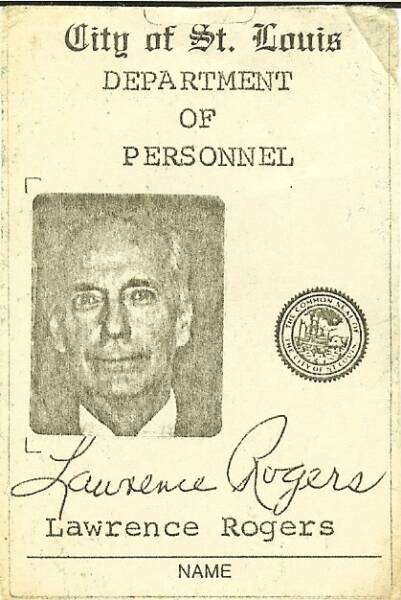
Lawrence E. Rogers was born in St. Louis, Missouri on May 2, 1920. He had two brothers and three sisters. His parents owned a small grocery store near Sportsman’s Park (the baseball stadium). The family lived above the store.Larry attended CBC High School and then went to St. Louis University where he earned Bachelor of Arts and Master of Arts degrees in History and Government.For most of his career, he worked as a training coordinator for the St. Louis City Personnel Department. Larry taught supervision and management classes to city department officials and to fire department captains.In 1958, Larry married Ann Catherine Kearns, a grade school teacher. Larry and Ann had one child, Joseph.After his retirement, Larry established a small bookstore that specialized in children’s books. He wrote a workbook called Clarity in Handwriting that has been used by students at many schools.Larry also wrote some short stories -- The Perils of a Cautious Man and The Stalker -- and a non-fiction book entitled After Death, A New Life (a discussion for persons of all religious denominations). This work contains many great quotations from some writers and philosophers.